Tuesday, June 23, 2009
Vegan strength
Stereotypes, anyone? Check out these powerlifting vegans:
Vegans Win Weightlifting Competition
VeganStrength.org
Monday, May 25, 2009
Why vegetarian feminists are upset with PETA
You wouldn't think that feminism and animal rights activism would be mutually exclusive ventures, but even if they offered me a job, I would never work for PETA (and in this frosty economy, no less!). This is not because I love fur, leather shoes, or pepperoni pizza - with the possible exception of my vintage cowboy boots, I could, and do, live happily without all three. In fact, I'm a lifelong vegetarian. I've never eaten beef or pork (except for the occasional hot dog when I was 5, before my father told me that they eat cat in Africa and I made the Lisa Simpson connection between lambs and lamb chops), and I stopped eating all meat when I was 10, so I think I have pretty good vegetarian street cred. I cried in the middle of a cafe earlier this year while reading a Michael Pollan article about cattle raised for beef (read it - it made me go vegan for three months before I got anemia from my college dining halls) - it's incredibly easy to get me worked up about animal rights issues, and if there were more than 24 hours in the day, I would be devoting time to animal rights activism.
But I'm also a lifelong feminist, and I have been increasingly shocked and horrified by PETA's casual exploitation of gender stereotypes and objectification of the female body in an effort to raise support for its activism. If you've seen any of PETA's ads, you know what I'm talking about. This commercial was banned from the Super Bowl, for obvious reasons (surely there are ways to convince people to go vegetarian without showing a scantily clad woman preparing to fuck a bunch of asparagus), but PETA has repeatedly launched advertisements which throw respect for women (or, for that matter, for men) out the window in the name of animal liberation. Just a few examples: Alicia Silverstone stripped naked for a PETA ad, with the tagline "I'm a vegetarian" above her obviously airbrushed body. The strippers of Rick's Cabaret posed nude for another ad campaign, which declared "We'd rather go topless than wear fur." In a demonstration last year, PETA used a pregnant woman in a cage as part of a demonstration against mistreated pigs. And just to prove that they could perpetuate damaging male stereotypes as well as sexualizing women, PETA produced an ad last year featuring Mickey Rourke, who inveighed upon viewers to "have the cojones to fix your dog." Sometimes they like to use a psuedo-feminist, "love your body" type of rhetoric to mask the fact that they're blatantly exploiting women's bodies (tagline: "Be comfortable in your own skin: don't wear fur"). But usually, PETA throws itself behind campaigns that unashamedly objectify women in the service of "justice."
This is similar to problems that I have with other methods used to encourage people - usually women - to go vegan. On Princeton's feminist and gender issues blog, Equal Writes (shameless plug: I'm a co-editor), I wrote a post about the "Skinny Bitch" book series, which play on women's insecurities about their bodies to shame them into changing their diet. Another post on this blog points out the obvious problems in encouraging girls to stop eating meat because it will "make you fat" (another one from PETA - it boggles my mind that they're not called out more often for this shit). The really aggravating thing for me, though, is that vegetarianism is in many ways a healthier diet. So why tell women that veganism is the way for them to become a "skinny bitch" rather than a "healthy woman"? Because it's easier to play on women's existing negative self-image. Our culture has done a great job of laying the groundwork for anyone to shame women into eating proscriptively, and rather than helping women feel better about their bodies - and at the same time, work for animal rights - PETA and other activists take the low road.
The problem, at the most fundamental level, is that we're not acknowledging intersectionality. This is not something that's limited to animal rights activists - American Apparel is a great example of a company which uses women's bodies to sell clothes that were made under decent working conditions - apparently, we can't have happy workers and desexualized models (for a more in-depth rant, I've written two posts, linked here and here, about American Apparel on Equal Writes). Why can't we humanize animals in the attempt to make people care about the way that they're mistreated, rather than dehumanizing women?
Animals, women and workers are frequently denied full rights as living creatures. But using women to gain rights for animals is not really progress. And what does it say about the movement itself if the only way to convince people to treat animals with respect and dignity is to sex it up? Why not show images of slaughterhouses, rather than assuring us that greased-up naked women don't eat meat (and please, just because Playboy does it, doesn't make it ok - they're not trying to take some kind of moral high ground)? Why not tell people that it's actually healthier to eat less meat, rather than telling women that it's the only way they'll get skinny? It's desperate and tacky and offensive to promote justice for one cause at the expense of another. And it makes it impossible for me to respect an organization that logically I should love.
I'd also like to note that PETA's advertisements have recently strayed into the realm of racism (beyond the fact that the vast majority of their nekkid models are white). Last year, there were discussions of renting ad space on the border fence between the U.S. and Mexico, for billboards that equated a carnivorous diet with the border patrol. The billboards, in English and Spanish, would offer the caution: "If the Border Patrol Doesn't Get You, the Chicken and Burgers Will - Go Vegan." I'm not sure what the status is with these ads, but the very idea that this is an acceptable strategy is totally unbelievable. The images on the billboards are definitely racist, and content aside, what the hell is the idea behind giving the U.S. government money to support its fucked-up immigration policies?
I'd love to see the day when animal rights activists acknowledge the connections between abuse of animals and abuse of women. But I will never get behind any organization that so flippantly disregards health, self-esteem, and the female body. Thanks, PETA, for trying to promote your issues through misogyny and racism. And until it's willing to take the road of basic decency and stop using tired stereotypes and "sexy" advertising tropes, I'll keeping throwing up in my mouth at the mention of its name. I don't know how many converts PETA's gotten from these ad campaigns, but it's definitely lost my support.
Wednesday, May 20, 2009
PETA, Pets, and Extinction
I’ve always been surprised by the number of people who criticize PETA for operating animal shelters which euthanize animals. There are certainly many grounds on which to criticize PETA, but I’ve never thought the fact that they kill unwanted pets which no one is capable of providing for is a particularly good one. Ultimately, euthanizing animals which cannot reasonably be treated to a meaningful and pleasurable life is clearly consistent with the utilitarian philosophy from which many animal rights activists draw inspiration (note, for example, Peter Singer’s strident support for human euthanasia and infanticide, alongside his concern for animals). Frankly, the “hypocrisy” of PETA euthanizing animals is far less than the hypocrisy of the many “animal-lovers” who eat meat but love their pets enough to cry foul when PETA chooses the least-bad option to address the systematic problem of pet overpopulation.
A recent poster on this blog, however, offered a more intriguing allegation: that PETA’s euthanasia policy is part of a broader attempt to make pets extinct.
There are a few reasons why the elimination of pets might be bad news for humans. First off, there are the obvious uses of companion animals for assisting blind and deaf individuals. Most of us have heard about the medical and psychological studies that have shown that having pets makes human beings healthier. These are, of course, scientific attempts to codify common sense: most of us know that in a world where humans are often atomized and isolated from one another, pets provided much needed friendship, affection, and unconditional love.
My family “owns” two dogs, and I can certainly see simply from my own experience that all of the above are true. Nonetheless, I still find compelling the arguments of those who have suggested that domesticated animals are actually bad for humans in a broad sense. Jim Mason – who co-authored “The Way We Eat” with Singer in 2006 – wrote an earlier book, “An Unnatural Order,” that suggests that the subjugation of animals was, in a sense, a rehearsal for our later domination of the earth and one another. According to Mason, by dominating and domesticating animals, we create in ourselves a mindset that allows us to dominate more than just animals. It’s a complicated argument, but it’s worth considering, and it is consistent with less far-flung connections that have been demonstrated between abuses of animals and abuses of humans.
The point of being an animal rights activist, though, is that our sphere of ethical consideration is wider than just humans. And so, however we decided to weight the above evidence as to whether dogs and cats are “good” for humans, we ought also to ask whether it’s good for dogs and cats. In this respect, I have to agree with Gary Francione that if there were two dogs left on the planet, I would not let them breed.
I’m sure many of us who have derived a great deal of pleasure from the company of animals – myself included – shudder at the above statement. But when we really look at the root of the issue, I think the problem with the very idea of domesticated animals becomes clear. Fundamentally, PETA has to euthanize thousands of animals because we have bred entire species of beings that are completely helpless. Dogs and cats may seem happy, but – without being inside their heads – I imagine that their lives lack the fulfillment that would come from a free life in the wild. They are utterly dependent on others, and I submit that this means their lives can never be that much more valuable than that of a particularly well-treated human slave.
I sincerely doubt that PETA actually wants to rid the world of pets. PETA’s thinking tends to be short term and focused on the immediate alleviation of animal suffering (hence their support for things like Proposition 2 in California). I doubt something as far fetched as the elimination of pet ownership will ever make it onto their radar screen. But I do think that reconsidering our relationship with pets is important, if nothing but for the role such animals play in our broader mindset.
A recent poster on this blog, however, offered a more intriguing allegation: that PETA’s euthanasia policy is part of a broader attempt to make pets extinct.
There are a few reasons why the elimination of pets might be bad news for humans. First off, there are the obvious uses of companion animals for assisting blind and deaf individuals. Most of us have heard about the medical and psychological studies that have shown that having pets makes human beings healthier. These are, of course, scientific attempts to codify common sense: most of us know that in a world where humans are often atomized and isolated from one another, pets provided much needed friendship, affection, and unconditional love.
My family “owns” two dogs, and I can certainly see simply from my own experience that all of the above are true. Nonetheless, I still find compelling the arguments of those who have suggested that domesticated animals are actually bad for humans in a broad sense. Jim Mason – who co-authored “The Way We Eat” with Singer in 2006 – wrote an earlier book, “An Unnatural Order,” that suggests that the subjugation of animals was, in a sense, a rehearsal for our later domination of the earth and one another. According to Mason, by dominating and domesticating animals, we create in ourselves a mindset that allows us to dominate more than just animals. It’s a complicated argument, but it’s worth considering, and it is consistent with less far-flung connections that have been demonstrated between abuses of animals and abuses of humans.
The point of being an animal rights activist, though, is that our sphere of ethical consideration is wider than just humans. And so, however we decided to weight the above evidence as to whether dogs and cats are “good” for humans, we ought also to ask whether it’s good for dogs and cats. In this respect, I have to agree with Gary Francione that if there were two dogs left on the planet, I would not let them breed.
I’m sure many of us who have derived a great deal of pleasure from the company of animals – myself included – shudder at the above statement. But when we really look at the root of the issue, I think the problem with the very idea of domesticated animals becomes clear. Fundamentally, PETA has to euthanize thousands of animals because we have bred entire species of beings that are completely helpless. Dogs and cats may seem happy, but – without being inside their heads – I imagine that their lives lack the fulfillment that would come from a free life in the wild. They are utterly dependent on others, and I submit that this means their lives can never be that much more valuable than that of a particularly well-treated human slave.
I sincerely doubt that PETA actually wants to rid the world of pets. PETA’s thinking tends to be short term and focused on the immediate alleviation of animal suffering (hence their support for things like Proposition 2 in California). I doubt something as far fetched as the elimination of pet ownership will ever make it onto their radar screen. But I do think that reconsidering our relationship with pets is important, if nothing but for the role such animals play in our broader mindset.
Monday, May 18, 2009
Vulcan Vegetarians

In case the new Star Trek movie hasn't already caught your interest, consider that Vulcans are committed to a vegetarian diet and way of life. This most notably includes Spock, a vegan, originally portrayed by vegetarian actor Leonard Nimoy. Vulcans are ethical vegetarians, and their philosophy of non-violence states that "It is illogical to kill without reason."
Vegetarian and Vulcan enthusiasts alike can even sport these "Live Veg and Prosper" shirts from Peta, based on the famous Vulcan saying.
Monday, May 04, 2009
Are we all terrorists?
As many of you have perhaps already heard, the animal rights’ community reached a new milestone this week when Daniel Andreas San Diego was placed on the FBI’s Most Wanted list (you can read about it here). San Diego is the first “domestic terrorist” to make the list, as well as the first animal rights activist. Without engaging the complex question of whether or not direct action to liberate animals is justified, I have two points to make.
The first, of course, is that the placement of San Diego on the FBI most wanted list is completely ridiculous. In the press conference they held for the announcement, Special Agent Charlene Thornton stated that “Mr. San Diego and those like him are every bit as great a threat to the peace and security of the United States as any foreign terrorist.” This assertion is patently inane. San Diego planted two bombs in a deserted office building and set them off at a time when the building was assuredly unoccupied, causing minor damage and no injuries.
The issue of whether or not actions like Diego’s are effective or justifiable is a prickly one, but whether you think this guy is a deranged misanthrope or a modern-day abolitionist, it’s clear he’s no Osama Bin Laden. While I realize that we’re not all utilitarians here, I think that most of us would be willing to agree that killing three-thousand people is worse than killing zero. Even making a comparison closer to home, it is clear San Diego is not on par with, say, Timothy McVeigh, or any other right wing militia group that has no compunctions about killing human and non-humans alike. That point, though, has been made more effectively by others. Will Potter, at greenisthenewred.com, has spent years chronicling how anti-property “violence” by environmental and animal rights activists has been blown completely out of proportion. Indeed, Potter suggests that the timing of the announcement about San Diego was probably politically motivated.
The more significant thing I want to argue here, though, is a bit less obvious. It starts with another article about alleged terrorists that details how the United States used the torture technique “waterboarding” 266 times on two Arab terrorist suspects. While San Diego and the two victims in this case – Abu Zubaydah and Khalid Shaikh Mohammed – might share the label “terrorist,” as I pointed out above the similarities pretty much end there. Moreover, we in the animal rights community aren’t really supposed to care about cases like Zubaydah and Mohammed’s. After all, groups like PETA – through partnerships with conservative groups and right-wing pundits like Pat Buchanan – have consistently rejected the idea that social justice issues that do not involve animals fall into their purview. Indifference to these issues is not just a product of a few organizations, though: sociological research into the animal rights movement has consistently found animal rights activists to be some of the most single-minded single-issue activists out there.
What I think that San Diego’s case shows, though, is that animal rights activists can ignore the happenings of society at large only at their own peril. Commentators like Will Potter at greenisthenewred.com are keen to argue that the animal rights and environmental movements are being singled out and targeted, through legislation like the Animal Enterprise Terrorism Act. Honestly, though, I think Potter is wrong. What happened to San Diego – as well as groups like the SHAC 7 who were involved in more explicitly non-violent behavior – is emblematic of a society that is deeply repressive at large.
I am often told that vegans need to present themselves as non-threatening. While to some extent this is a warning against vegans covering themselves in tattoos and piercings that are off-putting to everyone else, I think that admonition – which has a lot of currency in the movement – has deeper significance. I believe a lot of animal rights activists want to convince everyone else that we really are just in it for the animals, and we’re not going to challenge anything else. And maybe that’s what some activists want: a vegan “utopia” where animals are left unharmed but everything else – capitalism, consumerism, American international arrogance – remains the same.
Personally, I think such a society would be no utopia at all. We would do well to remember that Nazi Germany had the most pro-animal laws of any modern Western country. As I have argued, animal rights activists like the SHAC 7 are undermined more broadly by our country’s anti-terrorism and anti-crime hysteria. But more than that, I think the principles we ought to stand for – equal consideration, respect, dignity, and sustainability – are under attack both for humans and non-human animals.
I submit, then, that if every single person in the world went vegan tomorrow, we as animal rights activists should not rest a minute, but should immediately dedicate ourselves to other problems. Society needs an overhaul, and I think that animal abuse is only one symptom of much deeper problems.
The first, of course, is that the placement of San Diego on the FBI most wanted list is completely ridiculous. In the press conference they held for the announcement, Special Agent Charlene Thornton stated that “Mr. San Diego and those like him are every bit as great a threat to the peace and security of the United States as any foreign terrorist.” This assertion is patently inane. San Diego planted two bombs in a deserted office building and set them off at a time when the building was assuredly unoccupied, causing minor damage and no injuries.
The issue of whether or not actions like Diego’s are effective or justifiable is a prickly one, but whether you think this guy is a deranged misanthrope or a modern-day abolitionist, it’s clear he’s no Osama Bin Laden. While I realize that we’re not all utilitarians here, I think that most of us would be willing to agree that killing three-thousand people is worse than killing zero. Even making a comparison closer to home, it is clear San Diego is not on par with, say, Timothy McVeigh, or any other right wing militia group that has no compunctions about killing human and non-humans alike. That point, though, has been made more effectively by others. Will Potter, at greenisthenewred.com, has spent years chronicling how anti-property “violence” by environmental and animal rights activists has been blown completely out of proportion. Indeed, Potter suggests that the timing of the announcement about San Diego was probably politically motivated.
The more significant thing I want to argue here, though, is a bit less obvious. It starts with another article about alleged terrorists that details how the United States used the torture technique “waterboarding” 266 times on two Arab terrorist suspects. While San Diego and the two victims in this case – Abu Zubaydah and Khalid Shaikh Mohammed – might share the label “terrorist,” as I pointed out above the similarities pretty much end there. Moreover, we in the animal rights community aren’t really supposed to care about cases like Zubaydah and Mohammed’s. After all, groups like PETA – through partnerships with conservative groups and right-wing pundits like Pat Buchanan – have consistently rejected the idea that social justice issues that do not involve animals fall into their purview. Indifference to these issues is not just a product of a few organizations, though: sociological research into the animal rights movement has consistently found animal rights activists to be some of the most single-minded single-issue activists out there.
What I think that San Diego’s case shows, though, is that animal rights activists can ignore the happenings of society at large only at their own peril. Commentators like Will Potter at greenisthenewred.com are keen to argue that the animal rights and environmental movements are being singled out and targeted, through legislation like the Animal Enterprise Terrorism Act. Honestly, though, I think Potter is wrong. What happened to San Diego – as well as groups like the SHAC 7 who were involved in more explicitly non-violent behavior – is emblematic of a society that is deeply repressive at large.
I am often told that vegans need to present themselves as non-threatening. While to some extent this is a warning against vegans covering themselves in tattoos and piercings that are off-putting to everyone else, I think that admonition – which has a lot of currency in the movement – has deeper significance. I believe a lot of animal rights activists want to convince everyone else that we really are just in it for the animals, and we’re not going to challenge anything else. And maybe that’s what some activists want: a vegan “utopia” where animals are left unharmed but everything else – capitalism, consumerism, American international arrogance – remains the same.
Personally, I think such a society would be no utopia at all. We would do well to remember that Nazi Germany had the most pro-animal laws of any modern Western country. As I have argued, animal rights activists like the SHAC 7 are undermined more broadly by our country’s anti-terrorism and anti-crime hysteria. But more than that, I think the principles we ought to stand for – equal consideration, respect, dignity, and sustainability – are under attack both for humans and non-human animals.
I submit, then, that if every single person in the world went vegan tomorrow, we as animal rights activists should not rest a minute, but should immediately dedicate ourselves to other problems. Society needs an overhaul, and I think that animal abuse is only one symptom of much deeper problems.
Friday, May 01, 2009
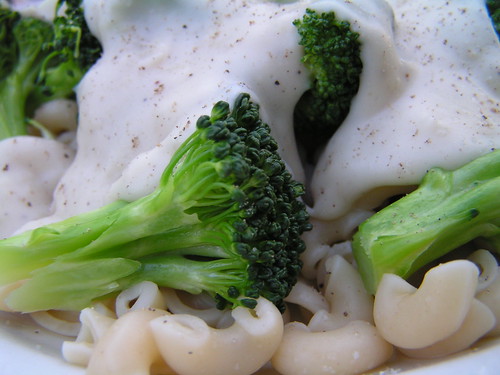
Quick Bechamel sauce
My kitchen is currently non-existent so apologies for the lack of posting. Here is an easy Bechamel sauce from the ppk website served on WW macaroni and steamed broccoli.
When water is boiling place basket with broccoli over water. Once boiling, add pasta and return brocolli to steamer.
Meanwhile, make this quick and easy sauce. I adjusted the seasoning with extra salt, garlic power, onion powder and paprika with nutmeg like the french do.
Very rewarding and filling.
When water is boiling place basket with broccoli over water. Once boiling, add pasta and return brocolli to steamer.
Meanwhile, make this quick and easy sauce. I adjusted the seasoning with extra salt, garlic power, onion powder and paprika with nutmeg like the french do.
Friday, April 17, 2009
Defending the Indefensible
People will go to great, sometimes absurd lengths to defend that which they hold dear, when it is under attack. In response to last week’s San Francisco Board of Supervisors resolution commending restaurants that have stopped serving foie gras, determined foodies have rushed to the defense of the right to consume the excessively-priced, fattened, and diseased liver of force-fed ducks and geese. In a Wednesday column in the San Francisco Chronicle entitled “In Praise of Foie Gras,” Caille Millner attempts not only to defend the indefensible, but to glorify what is arguably the cruelest delicacy known to man. By wildly distorting the reality of foie gras, Millner puts a happy face on profound suffering.Millner’s piece made my blood boil. Thanks to her skewed claims, thousands of restaurant-goers won’t think twice the next time they see foie gras on the menu. But there's reason for hope. Beyond its superficial claims, Millner's article signals just how out of touch with public opinion anyone who defends foie gras is these days. Millner resorts to patently clumsy and contrived arguments (see below). Clearly, she is on the defensive. Her painting of the anti-foie gras crusade as a raging fad, and her community of foie gras foodie enthusiasts as noble yet misunderstood guardians of a sacred right – lone voices of reason in a sea of confusion – signals just how unpopular foie gras is these days. The desperation of her plea is a testament to the success of the anti-foie gras campaign and more broadly to the fact that, as Nicholas Kristof put it in the New York Times last week, “animal rights are now firmly on the mainstream ethical agenda.”
But Millner is undeterred. She closes on a note of triumph, “Commend away, San Francisco. I'll be just across the city lines, eating without guilt.” What she fails to note is that quite soon, crossing city lines won’t be enough. Thanks to a bill signed by Governor Schwarzenegger in 2004, the sale and production of foie gras will be banned in California in 2012.
See you in Nevada, Caille.
Thankfully, Millner’s claims are not hard to refute. She uses lines of reasoning and rhetorical devices that are nearly universal in defenses of animal cruelty. I think it’s instructive to flesh these out and consider how we can best respond.
Tactic: Crying anthropomorphism
Her claim: “Most people are prone to anthropomorphize, so they imagine how horrible it would be to have a tube shoved down their own throat (ducks do not have voice boxes or gag reflexes; they breathe through their tongues) and agree that it's a horrible process that must be stopped.”
Why it works: Crying anthropomorphism always scores points. The suggestion is that those who care about animal suffering have fallen prey to childish sentimentality. It lends an air of scientific credibility to those opposing animal rights and suggests that empathy is irrational.
Response: For starters, her claim that geese lack a gag reflex is questionable. The Scientific Committee on Animal Health and Animal Welfare (SCAHAW), the EU’s most authoritative scientific body on farm animal welfare, reported that “the oropharyngeal area is particularly sensitive and is physiologically adapted to perform a gag reflex in order to prevent fluids entering the trachea. Force feeding will have to overcome this reflex and hence the birds may initially find this distressing and injury may result.” But this is beside the point, because the inherent and undeniable cruelty of foie gras is not the force-feeding itself but the resulting enlargement of the bird’s livers to 6-10 times their natural size, inducing injury, disease, and lameness. Millner makes no mention of this.
Tactic: Displacing culpability/defense by commonality
Her Claim: “The means of production for the vast majority of the country's meat supply are at least as horrifying as what it takes to produce foie gras, but it's much harder to demonize the vast majority of Americans for what they eat.”
Why it works: One of the easiest ways to excuse someone for their evils is to point out that a whole lot of other folks are doing the exact same thing or even worse things. Suddenly, it’s unfair to single out that particular evil over other equally horrible evils. Basically she is saying “all meat production is cruel so why don’t you lay off foie gras.”
Response: The claim that the farm animal rights movement is singularly focused on foie gras is absurd. The resources put into all the foie gras campaigns across the country are minuscule in comparison to those invested in Proposition 2, alone.
Tactic: Distortion and irrelevant claims
Her Claim: “Never mind that there are only three foie gras producers in the United States, all small farms that are paragons of humane treatment compared to our country's countless factory farms….All three foie gras farms in the United States use open pens for their ducks and have very low mortality rates.”
Why it works: When there isn’t supporting evidence for your case, sometimes you just have to make things up. Here, Millner exploits the common image of “small” farms as humane and idyllic.
Response: The smallness of foie gras farms and the quality of living conditions do not affect the cruelty inherent in the force-feeding process. And are the farms in this investigation video (including the three she mentions) truly “paragons of humane treatment?” The housing looks wretched. Low mortality rates (a highly subjective term that she doesn’t quantify) don’t mean much, given that the ducks are slaughtered at only 4 months of age. Moreover, one can think of plenty of forms of torture, human and animal alike, that don’t result in death.
Tactic: Framing issue as human rights vs. animal rights
Her Claim: “Never mind that so many enormous issues - climate change, obesity, health care - are tied up in our country's cheap meats, not its expensive ones. And certainly never mind that the leadership of San Francisco has far bigger things to worry about than whether or not people should be eating foie gras.”
Why it works: Animal cruelty apologists like to suggest that that human rights and animal rights are mutually exclusive. Here, Millner implies that those campaigning against foie gras are squandering time that could be spent working on more important, presumably human issues.
Response: This is not a human life vs. animal life issue. This is a relishing-in-the-fleeting-taste-of-flesh-produced-through-enormous-cruelty vs. finding-something-else-to-eat, issue. The passing of this resolution required little time on the part of the council. Furthermore, the council resolution will have an impact far beyond city limits. Since San Diego passed a similar resolution last year, other cities in Southern California have done the same. The San Fran resolution is likely to have a similar ripple effect.
Tactic: One-sided quotes
Her Claim: "We were the first farm to use a humane auditor," said Rick Bishop, animal welfare officer for Hudson Valley Foie Gras in Ferndale, N.Y. …“We've always fought misinformation by having an open-door policy at our farm. Anyone who wants to see what we're doing is welcome to visit and observe at any step of the process."
Why it works: It’s simple. Quote somebody that agrees with you and pretend that he or she is an expert.
Response: Thanks to Hudson Valley’s transparency, activists with Compassion Over Killing took up the offer for a free tour. The problem is, they caught it on tape.
Tactic: Appeal to personal investment in cruelty
Her Claim: “A dollop of foie gras is a creamy, rich flavor explosion. Prepared properly, it has wonderful texture - the word "mouthfeel" should have been invented for it - and, like wine, can have notes of flowers, citrus, nuts. I love it.”
Response: Hmmm, I guess the 15 countries that have banned foie gras weren’t aware of how yummy it tastes.
Thursday, April 16, 2009
Tempermant Testing Fails to Evaluate Shelter Dogs
While I was interning at Farm Sanctuary a dog was dumped on its grounds. As the farm does not take in dogs, he was sent to Tompkins County SPCA, a no-kill shelter in Ithaca. When I called to check up on him, I learned that he was scheduled to be put down that day because he had failed temperament testing. He tested positive for "rough play," "possession aggression" and "food aggression". Having spent time with the dog, I knew this could not be the case. After arguing with staff on the phone they agreed to hold him until 5pm and release him to me, as he was "dangerous" and "un-adoptable."
I was able to watch a video of the tests they did to evaluate him. During one, he was chained to a wall in two spots and poked at with a large rubber arm on a stick. He was given pig ears and other treats while the arm poked at his face trying to knock food, toys and pig ears out of his mouth. At some point, he growled, backed away from the arm and snapped. This led them to deem him too dangerous to be adopted. During another test, they had him play and jump on a man with a hockey stick, who would use the stick to block and push the dog off and rough him up. This was deemed rough play, but was not enough to fail him.
I had to sign legal forms, which said that the dog cannot live in Ithaca, is a danger to society and that I accept all responsibility. After being warned again about how dangerous he was, they walked him out and when he saw me he trotted over and placed his head over my shoulder and tried to curl up in my lap. He sat there, leaned into me and licked my cheek. When I stood back up to sign the rest of the forms he trotted over to my friend, Zoe, (who he'd never met until then) and leaned into her chest with his head waiting for the affection.
This is the e-mail I wrote to the shelter about how Party (that is his name) has been doing since I took him home. My hope is to make them realize the inadequacies of their temperament tests. Party tested positive for rough play, food aggression and possession aggression. In y experience with party, he has neither.

He is the sweetest boy I have ever met and he loves everyone. In no way is he "a danger to society".
I was able to watch a video of the tests they did to evaluate him. During one, he was chained to a wall in two spots and poked at with a large rubber arm on a stick. He was given pig ears and other treats while the arm poked at his face trying to knock food, toys and pig ears out of his mouth. At some point, he growled, backed away from the arm and snapped. This led them to deem him too dangerous to be adopted. During another test, they had him play and jump on a man with a hockey stick, who would use the stick to block and push the dog off and rough him up. This was deemed rough play, but was not enough to fail him.
I had to sign legal forms, which said that the dog cannot live in Ithaca, is a danger to society and that I accept all responsibility. After being warned again about how dangerous he was, they walked him out and when he saw me he trotted over and placed his head over my shoulder and tried to curl up in my lap. He sat there, leaned into me and licked my cheek. When I stood back up to sign the rest of the forms he trotted over to my friend, Zoe, (who he'd never met until then) and leaned into her chest with his head waiting for the affection.
This is the e-mail I wrote to the shelter about how Party (that is his name) has been doing since I took him home. My hope is to make them realize the inadequacies of their temperament tests. Party tested positive for rough play, food aggression and possession aggression. In y experience with party, he has neither.
Hello,
This is Amanda Dickie. Your shelter redeemed a young dog named Party dog to me last November. I just wanted to let you know that he is the sweetest dog out there. And despite what your tests may have indicated, he does not have possession aggression or food aggression. He met my mother for the first time on the ride home and was eating chips out of her hand the whole way back.
When we arrived home we had him sitting and waiting for his food. Once or twice he jumped the gun and started eating before he had permission, but my 54 -year-old mother was able to control him without protest. After he got settled here everyone approaches him while eating and he is fine. My mother and I regularly take his food dish from him while he is eating and just waits for us to give it back.
He is learning to take treats from people gently. Whenever he is too rough, we take the treat back and try again until he gets it right. He has never growled, snapped or bitten anyone since leaving your shelter. We have four cats, who occasionally eat out of his bowl. When they do this, he sits back and waits for them to finish.
There is a constant flow of new and strange people in our house and party is excited and happy to meet everyone of them. He no longer jumps on people when they come to the door, and is happy when strangers approach him. He also loves small children and is extra gentle around them.
This dog is one of the kindest, gentlest and friendliest dogs I have ever met. Kids pull his tail, blow in his ears and pull on his cheeks, but he never retaliates with aggression.
We just wanted to pass along this message in hopes that you might reconsider using temperament testing as it is an unfair system that sets perfectly adoptable and loving dogs up for failure.
Thank you,
Sincerely Amanda
506-849-3950
With Love, Amanda Dickie
"As long as people will shed the blood of innocent creatures there can be no peace, no liberty, no harmony between people. Slaughter and justice cannot dwell together."
- Isaac Bashevis Singer,Writer, Nobel laureate (1904-1991)

He is the sweetest boy I have ever met and he loves everyone. In no way is he "a danger to society".
Tuesday, April 14, 2009
Skinny Bitches or Bulimic Vegetarians?
IntroductionIn 2007, few people would have expected a "no-nonsense" book of "tough-love" for American females to become one of the most succeful vegetarian advocacy publications in the Western hemisphere. This book, Skinny Bitch, spawned a whole slew of products including a cookbook, an instructional book on pregnancy, a journal, and now three work out videos. Already, the original book has become an international bestseller, hung onto the New York Times bestseller list (including a breif spot at the top), has sold two million copies, and has been translated into 20 languages.
While many vegetarian and AR activists have welcomed this book with open arms, too few people have heeded to the criticisms that this book preys on female body insecurities. Below, I will discuss why disguising a vegetarian message within a frame about weight-loss/management is not only detrimental to the health of adolescent females and young women but also trivializes the radical political orientation of veganism by conflating it with a self-interested, faddish diet. In light of continuous research that links the adoption of vegetarian diets by teens to disguise and/or justify their eating disorders, the sizist discourse that shames and blames "fat" people, and the vogue-ing of vegetariaism for the mainstream, I suggest that vegans ally instead with feminist and radical social justice groups to promote body acceptance and HEALTH rather than societal acceptance and "health."
"I am a vegetaian: I don't eat meat... or anything for that matter."
Just several weeks ago, a paper published in the Journal of the American Dietetic Association proved suspicions that many teen girls choose vegetarianism as a cover for their extreme dieting measures. The authors of the study conclude that
current [adolescent and young adult] vegetarians may be at increased risk for binge eating with loss of control, while former vegetarians may be at increased risk for extreme unhealthful weight-control behaviors. It would be beneficial for clinicians to inquire about current and former vegetarian status when assessing risk for disordered eating behaviors.Though there may be health benefits from adopting a vegetarian diet, many who choose such diets do so as a guise to manage their weight in the most unhealthy ways.
John Cloud from The Times recentlyreported on this latest study:
in a 2001 study in the Journal of Adolescent Health, researchers found that the most common reason teens gave for vegetarianism was to lose weight or keep from gaining it. Adolescent vegetarians are far more likely than other teens to diet... [and] teens with eating disorders are more likely to practice vegetarianism than any other age group.So while the public and socially acceptable answer many teenage vegetarian girls for their vegetarian may be "to save the animals/environment," at least one out of five (and potentially over half) really adopted the diet primarily out of concern for the health and/or image of their body.
Cloud continues, summarizing the results of the study:
approximately 20% of the [teen] vegetarians turned out to be binge eaters...compared with only 5% of those who had always eaten meat...This disparity in extreme behavior disappeared between [the ages 19 to 23]... But among former vegetarians, that number jumped to 27%.Interestingly, teen vegetarians were four times as likely to be binge eaters than omnivores, but young adult vegetarians were no more likely, suggesting that many teen vegetarians started extreme dieting prior to their omnivorous counterparts. Most concerning is that over one of four those who had once been vegetarians as teens, but quit, were extreme dieters. That's twice the rate of eating disorders as among young adults who had never been or who still were vegetarian! The moral: the adoption of a vegetarian diet as a teenager for the primary purpose of body-management sets one up for serious risk of eating disorders in the future.
I Love them Bitches: Don't Have a Cow, You Fat Pig, LOL!
The authors and publishers of Skinny Bitch are not naive to the "self-loathing" young (and old) women feel as a product of modern capitalist patriarchal culture. The official Skinny Bitch website gives a concise description of the book, or at least why someone should be interested and pick the thing up:
If you can't take one more day of self-loathing, you're ready to hear the truth: You cannot keep shoveling the same crap into your mouth every day and expect to lose weight.The answer to self-loathing, the book suggests, it holds is not to accept and love one's body, but to stop eating crap and lose weight--nevermind that many of the readers of the book are proabably already at a healthy weight.
Of course, the point of the book is not to make girls into "skinny bitches" but into veg*ns with jarring editorializations of meat processing and propoganda. The title is just a diversion to get people to pick up what Julie Klausner, in a scathing review of the book at Salon described as "a PETA pamphlet in chick-lit clothing and an innovative fusion of animal rights with punitive dieting tactics that prey on women's insecurities about their bodies." According to a previous review in the New York Times
[o]ne South Cal botique has sold more than 2,000 copies of Skinny Bitch because "[customers] just like the title." Likewise, one fasion publicist said that she "would never have read 'The Omnivore’s Dilemma.' I’m not even sure I know what an omnivore is. But I know what a skinny bitch is, and I know I want to be one."To put it simply, the Skinny Bitch franchise is so popular largely due to the clever marketing that went into it. As the fasion publicist said, women know skinny bitches, and they know they want to be them; they don't necesarily know (or care) what an omnivore or a vegan is. With a title like Skinny Bitch, the book drew on a much larger, mainstream audience, like a magnet for body-insecure women. But is this more of a succss for vegetarianism or perpetuating body-image anxiety?
Klausner would probably agree with he latter: Skinny Bitch is more likely to perpetuate eating disorders than to nurture a sustainable compassion for animal others:
The relentless bullying peppered throughout the authors' advice accounts for much of the book's humor, including quips like "you need to exercise, you lazy shit," "coffee is for pussies" and "don't be a fat pig anymore." It was a formerly anorexic friend of mine who nailed it when she read excerpts from the book. "When you have an eating disorder," she told me, "that's the voice you hear in your head all the time."The authors of the book, understand that bullying voice internalized in women from all races, classes, and regions of America that drives them toward unhealthy eating, and they are not afraid of exploiting it to humorously shaming/motivating people into eating "better" food. How ever tongue-in-cheek the humor of their tough-love style is, it trivializes that oppressive voice within women's heads and further validates false associations between fat/stupid/lazy/bad and thin/smart/agency/good. In many ways, the humor actually is apologetic for that oppressive voice as well as mysoginism and sizism.
PETA: People Encouraging Teen Anoretics?
The title of tis section may be hyperbole, but I also don't believe it is totally out-of-hand or false. On the contrary, the success of the Skinny Bitch franchise comes after almost two decades of PETA "selling" vegetarianism and sex in the form of attaining a more beautiful and virile body, which is almost always abnormally thin and fit. PETA, which unlike Skinny Bitch does not garb its political agenda in weight-management discourse, is no less the culprit of perpetuating body-image anxiety. The organization often utilizes fat phobia and sizism to shame/motivate people to adopt a veg*n diet. For instance, Vegan Kid notes that, according to PETA's video"Chew on This: 30 Reasons to Go Vegetarian," the #3 reason to go vegetarian is because "meat and dairy make you fat." Of course, many other things "make you fat," and meat and dairy need not be any of these things. They prioritize this "fact" because they know that most people are already insecure if not ashamed of their weight and size, and as such, it may be more compelling than reason #11 "because it is violence that you can stop."
Another example of the "fat" phobia/shaming done by PETA is in a response to Jessica Simpson's "Real Girls Eat Meat" shirt on the official PETA blog. According to this PETA employee, the #4 reason that "Only Stupid Girls Brag about Eating Meat" is that
Meat will make you fat. All the saturated fat and cholesterol in chicken wings, pork chops, and steak eventually leads to flabby thighs and love handles. I hope the upcoming "Jessica Simpson's Intimates" line comes in plus sizes! Going vegetarian is the best way to get slim and stay that way.Here again, just like we saw with Skinny Bitch, is the perpetuation of the stereotype linking size to stupidity--something that has been common at least since the pseudo-science of physiognomy. Worse of all is that PETA even has the audacity to distribute "Chicken Chump Cards"--which are still available at their online store and Petakids.com--to kids, of wich one shames fat children. On the front of the card is a sad, morbidly-obese child entitled "Tubby Tammy;" on the back it explains "how" chicken makes you so fat you'll have to wear a bungeecord for a belt.
Again, these three cases of fat phobia/shaming are in no way trivial. Each is part of a highly calculated marketing tactic to "sell" vegetarianism as a social panacea. The discourse in the blurbs and visuals has little to do with enhancing and sustaining health (or even a healthy body weight), but about looking your best for society which will reject you as a big fat, stupid person who is probably less compassionate and more self-indulgent than the other kids.
Unfortunate for the well-intentioned female animal advocates of PETA, those who do not conform to the mainstream's socially acceptable standard of beauty for women, the very standards PETA perpetuates, will be harassed and shunned. Take for instance the reactions at Perez Hilton to a publicity stunt in which a pregnant woman posed in a mock-gestation crate to protest hog farms. Comments included:
Yikes, I get the picture, but hmm... saggy boobs= kinda gross!!!!Of course, no one deserves to be called such horrible, mysoginistic and speciesist names; but it would not be surprising if PETA, or some animal advocates in general, used the same rhetoric to attack a woman who was promoting pork. As is suggested in their anti-fur ads, "Be Comfortable in Your Own Skin," one blogger comments, PETA "is basically saying that yes, you should let animals keep their fur because you should be comfortable in your own skin–as long as you’re a size 2 and conventionally beautiful."What's a tubby naked bitch in a cage got to do with eating pork??
She needs to go on a diet
wtf is this about
ewwwwwwwww
Moo cow..UGLY
Why couldn't they have chosen an attractive female?
Lettuce Entertain You: Vegetarianism is the New Black
Nearly all of PETA's ad campaigns utilizes not just any woman (or man), but celebrities, and not just any celebrities, but particularly physically attractive ones who are actors and musicians. These celebrities, thus, are visual icons. There are few, if any ads of famous (and beautiful) female scientists, photographers, authors, scholars, etc. suggesting the organization values (or at least values the people who value) "entertainment" over "art," science, and literature. Such famous people may not be "cool" enough for PETA's campaign targeting youth. Vegetarianism and AR is being "sold" as the "in" thing, and as is evident with anti-fur slogans in the movement that publicly shame women for wearing fur (i.e. "the Trollsen Twins," "Fur is worn by beautiful animals and ugly people"), women who do not conform are not only moraly but physically ridiculed.
Let me emphasize that the use of such visual celebrities is very deliberate, and, as I believe, very misguided. The use of these celebrities over others emphasises not any moral, political, artisitc, or intellectual of the particular person being associated with vegetarianism and AR, but an image. One should go veg because vegetarians are pretty, hot, badass, or funny, not because they are social/political radicals healing injustices everywhere or writing/discovering something that will change the world. (Unfortunately, television, cinema, and the internet have made the former celebrities' images much more prominent and at the expense of the great works of scholars, scientists, artists, and social entrepeneurs).
To return to Chris' point, PETA dresses-up celebrities in vegetables instead of showing them eating vegetables because PETA doesn't really care what people eat so long as their "food" does not come from animals. For all they care, vegans could just eat a Boca burger, potato chips, and a soft drink--not exactly a nutritional powerhouse. The ads are intended not to promote HEALTH, but to promote an image. By dressing up celebrities in vegetables, PETA is marketing the vegetarian diet as either sexy and/or graceful. Vegetarianism, in a sense, is the latest fshion, "the color" of the 21st Century.
However, note that by framing vegetarianism and AR as an image, as an "in" thing, it easily can become an "out" thing. Many of these ads and campaigs which target younger audiences may influence thousands of people to try out vegetarianism and AR, but the question becomes "for how long?" If vegetarianism is a matter or being like a particular "cool" or "hot" celebrity, especially one whom may be obsolete in two years, as soon as another "cool" celebrity comes around who eats animals or people realize how potentially challenging a vegetarian diet can be (all the social and emotional maintenence that is involved) they may shrug it off; it's just not worth it, just as those irksome designer heels are just not worth it.
Basically, if one cares about animal "rights," veg*nism is essential to putting their values in practice, but veg*nism is only contingent if they care more about body-image, which can not only be attained a number of ways, but is also something that cannot be guaranteed by a strict vegetarian regime. Certainly one can be "vegan" and eat unhealthy foods and not exorcise, but some people are not naturally disposed to being "thin" as others--making the pursuit of thinness a futile journey. In the end, those people striving for thinness on a veg*n diet may be unhappy with the lax results and move on to "the next big thing" to lose weight so that they can achieve their "ideal" body size.
On the other hand, if vegetarianism is "sold" as a political-ideological-intellectual orientation and commitment, it becomes a part of one's values, and hence one's more permanent identity util those values change, if they change. Instead of going for numbers, if non-profits and other organizations went for outstanding citizens, we may have much stronger and longer-term advocates on our hands. So much of these attempts take the "shotgun" approach by trying to hit any and eveyone in a mass audience. Tragically, many of these politically active and radical people are being "turned-off" to the vegetarian message and thousands of dollars are being wasted because these ads and discourses more than likely alienate and offend potential ARAs who are not "thin" like the women in these ads, and more generally, unjustly contribute to the anxiety of girls outside the movement about their own body image.
This is an abridged version of the original, cross-posted @ HEALTH
tags:
celebrities,
dieting,
health,
literature,
PETA,
vegetarianism
Monday, April 13, 2009
Letter to the President
As some of you may have heard, Obama has back tracked on his promise to adopt from a shelter and has sadly gone to a breeder. I took some time to write him a letter and would suggest if this or anything else upsets or disappoints you that maybe you take the time to write one too.
I just wanted to let you know how disappointed I am that you bought a dog from a breeder. There are plenty of hypo-allergenic dogs dying for good homes across your country and you've just signed their death warrant. Sir, you may only be one man, and one family providing a single home for your new dog and closing a single door for the other dogs in need, but your actions are broadcast globally and have far greater effects.
As the president people look up to you and will likely follow your example. You had a real shot to make a difference, but you have let us down. Setting this precedent will make it significantly more difficult for homeless dogs to find loving homes.
Sincerely disappointed,
Amanda Dickie
Subscribe to:
Posts (Atom)