Saturday, April 10, 2010

Are Oysters Vegan?


Christopher Cox, a self-labeled vegan, just wrote a trenchant and provocative article at Slate.com, in which he defends his decision to eat oysters. Predictably, the article is drawing a firestorm of criticism from many vegans, who are branding Cox a heretic.

I think the article is a must-read for veg activists. Cox digs into into tough but vital questions of labeling, purity, and absolutism. He writes:

"When I became a vegan, I didn't draw an X through everything marked "Animalia" on the tree of life. And when I pick out my dinner, I don't ask myself: What do I have to do to remain a vegan? I ask myself: What is the right choice in this situation? Eating ethically is not a purity pissing contest, and the more vegans or vegetarians pretend that it is, the more their diets start to resemble mere fashion—and thus risk being dismissed as such."

So, whaddya think?

P.S. If you find Cox's commentary interesting, check out Michael Greger's classic article on honey.


Wednesday, April 07, 2010

The Great Debate: To call yourself a vegetarian or vegan – PART II

As the co-moderator of this blog, nothing makes me happier than to see posts explode into lively, fiery debates. When I say fiery, however, I’m talking about igniting debate, not burning those who disagree with you. So I’m both thrilled to see that Kenny Torrella’s post yesterday set off a heated exchange and disappointed to see that some readers – on both sides of the issue – responded with bitter sarcasm.

Blog readers have every right to be pissed off by any view they disagree with, but there’s a big difference between being respectfully pissed and just plain out pissing on somebody else’s opinions. All I’m saying is be respectful, be civil, and most importantly, keep it real!

With that in mind, I’d like to extend an invitation to any interested readers to participate in this discussion. If you’re not a contributor on “Animal Writes,” but would like to weigh in by posting a guest entry, shoot me an email at benjidavidow@gmail.com

Now, moderator business aside, I’d like to take off my referee shirt and jump into the fighting ring with the understanding that everything I say is my personal opinion as an activist and not as the blog moderator. At the same time, I’d like to see if there’s any room for reconciliation between the sparring viewpoints.

To summarize, Kenny, a vegan farm animal activist (and a friend of mine, for full disclosure) argued from experience that labeling himself as vegetarian rather than vegan is more effective in outreach. He echoes the insights of Bruce Friedrich, who has found that talking about veganism right off the bat tends to overwhelm and turn away folks from engaging with the issue. Some readers retorted that a vegan who labels himself as vegetarian is dishonest and has sold out by neglecting animals that are exploited for dairy and eggs.

I agree with some of the commenters that there is profound inconsistency in ethically motivated lacto-ovo vegetarianism, since, for example, more animals are slaughtered in the egg industry than in the beef industry. However, for anyone doing veg outreach, the vital and never-ceasing question must be: how can I have the greatest impact for farm animals? In Bruce and Kenny’s experience, explicitly advocating veganism turns a slight fraction of people vegan at best, while advocating vegetarianism leads many down a path that often leads to veganism.

As Kenny notes, Jonathan Safran Foer, author of Eating Animals, has talked about the importance of asking people to take the first step rather than the last step. If Joe Shmoe takes the first step and sees how easy it is, he’s likely to take the next step. But if you ask Joe to leap to the finish line, he’s likely to walk away – probably in the opposite direction.

Imposing a moral baseline seems to me not only counterproductive, since it often turns people off from opening up to the issues, but also disingenuous, since nobody consumes a 100% cruelty-free diet. No vegan I know, myself included, eats in a way that causes zero harm to animals, farmers, laborers, or the environment. So holding up veganism as a moral ideal, even with the best of intentions, is misguided. The question is how to minimize our harm. Veganism is a huge step in that direction, but it is not the endpoint, and treating it as such tempts the language of self-righteousness and absolutism.

The comments on Kenny’s post reflect a broader rift in the animal rights community between so-called abolitionists and so-called welfarists. Abolitionists advocate an uncompromising pro-vegan stance and tend to oppose any incremental welfare reforms for farm animals, since they believe such reforms only reinforce the legitimacy of using animals for food. Welfarists, in contrast, believe that incremental steps forward for animal welfare are important and can be advanced in tandem with a non-exploitation ethic.

My sense is that these diverging viewpoints are rooted in deep convictions. To make a sweeping generalization, I think abolitionists place higher value on honesty, purity and idealism, while welfarists value efficacy, practicality, and nuance. Now, I bet that few welfarists or abolitionists would actually accept this categorization. A welfarist might believe that she is acting with more integrity, since in her view, renouncing efforts to improve welfare standards is doing a disservice to animals. An abolitionist might believe that he is acting with more efficacy, since welfare reforms, in his view, will turn away many potential vegetarians. My point is simply that where one falls on the abolitionist-welfarist spectrum is most often the product of underlying values (and formative experiences) and is unlikely to be swayed by means of debate.

Any conversation on effective outreach runs the risk of universalizing the matter and suggesting that some tactics are all-around superior to others. While some tactics will have greater success in some or most cases, there’s no one-size-fits-all formula for outreach. So it’s conceivable that while some or most vegans may be more effective talking about vegetarianism, other vegans, given their temperament or their convictions or who they’re talking to, may have more success talking about veganism.

At the end of the day, you won’t find the answers on how to do effective outreach in a book or on a blog; you’ll find them on the street where you can put different tactics and styles to the test. So the best advice I can offer is this: get out and find what works for you!

Tuesday, April 06, 2010

To call yourself vegetarian or vegan -- that is the question

(I took this from the Vegan Outreach blog -- whyveganoutreach.blogspot.com. The text in bold is from the blog, and below it is my own personal experience),

Bruce Friedrich, coauthor with Matt Ball on The Animal Activist’s Handbook and VP of PETA, has had personal interactions with literally thousands of individuals over the years (quite possibly, he has had more one-on-one conversations about animal issues than anyone else in the U.S.). He recently wrote:
I actually think that using the word “vegan” (other than perhaps with youth) may be counterproductive to helping animals, relative to using the word “vegetarian.” As a species, we are given to seeing things as “all or nothing," and I can’t tell you how many times I’ve had discussions with people who write off making any changes because they believe they can’t go vegan.

That’s why I no longer wear my “Ask me why I’m vegan” shirts – I wear the vegetarian ones, and the conversations have gotten SO MUCH BETTER. Where people used to be all about what vegan means and how hard it is to give up dairy (which saves 1/10 of an animal/year), now we talk about fish and chickens (saving many dozens of animals/year). I used to hear stories about dour and angry vegans; now I hear stories about daughters and cousins who are vegetarian.

This is anecdotal, of course, but it’s not theoretical – this is real-world and OVERWHELMING. I have FAR more people respond to my shirt now and approach me to ask questions. Before, I generally talked about what vegan means and the evils of dairy (still good, of course, but not nearly as valuable in helping animals). Now, I often have people tell me on the basis of one conversation that they will go vegetarian.

My long experience shows the word vegan scares many people, but the word vegetarian interests them (we also see this overwhelmingly when leafleting – people want vegetarian information far more than vegan information). Ironically, I’ll bet we get far fewer vegans by using the word vegan, since many vegetarians do go vegan, once they see how easy it is and start down the path of compassionate eating.
This is from this interview; more on this later in the week.

I read this a few weeks ago and have been experimenting with it lately, and I think it's a small tip for activists that goes a long way. For 2.5 years I had been telling people I was vegan if the subject came up. Now if people ask I say I'm vegetarian, and it makes a world of a difference. When I used to say I was vegan, people would immediately say some kind of variation of, "That's awesome, but I could never do that myself." Now when I say I'm vegetarian, people become more open and tell me about other vegetarians they know, vegetarian foods they've tried, how they've considered going vegetarian, or they had been vegetarian in the past and want to get back into it.

Whenever I met a vegetarian while leafleting, I used to say, "Have you considered veganism?" The situation would immediately turn a bit sour. For a split second they saw me as someone they had much in common with, and after asking if they've considered veganism, they see me as someone telling them to do more -- that their vegetarianism is not enough. Out of the number of vegetarians I had met and responded to like this, not a single one responded positively -- none said, "Why yes, I have been considering veganism lately!" All of them said a variation of, "Well, veganism seems like a good thing, but it's just too much for me." No matter how much cajoling, they wouldn't budge. The funny thing about this is that when I was a vegetarian I was the same way toward vegans. This is something important to remember. I didn't go vegan because another vegan was telling me to, or even telling me about it... I did it on my own after thinking about it and researching it for several months.

Now while leafleting, I give words of encouragement to vegetarians I meet. I tell them how awesome it is that they're vegetarian, to keep it up, I say "Aw, you're the best," I give them literature that has recipes and nutritional information. This makes a huge difference! They feel encouraged to do more, rather than being told to. They may not feel as alone in their choice if they meet another "vegetarian" that is also an activist and is thanking them.

Although our initial reaction is to identify as a vegan or to convince vegetarians to go vegan, 9 times out of 10 it doesn't turn anyone on to veganism -- it only makes them feel like they're being judged, as if their lifestyle choice to eschew all meat products was worth nothing. I'm not saying this is a fool-proof guide to live by and of course there are instances where it's important to say you're vegan, or if a vegetarian wants more information about going vegan, then by all means, hand out vegan literature and share your experiences as a vegan.

Although I was first skeptical of Friedrich's tip, I experimented with it and found it to be a much better approach toward turning more people on to a vegetarian lifestyle. I'd love to hear others' thoughts on this and if you try it out, let me know how it goes.

There are a lot of other great essays, articles and interviews here: http://www.veganoutreach.org/advocacy/index.html

The next article I write for this blog will be a general why and how-to on leafleting for Vegan Outreach and what I've learned from it.

Saturday, March 20, 2010

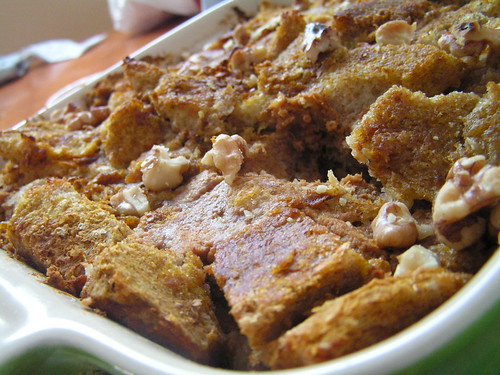
Pumpkin French Toast Casserole (or banana, apple, other fruit)


This is basically my lazy, casual rendition of French toast, with less work. This recipe is about using what you have on hand or things that you may have no other use for or are about to get up and leave you.

The original Recipe is from Vegan Brunch by Isa, amazing book and worth your hard earned money.


This recipe is great for when you have some stale or dry bread that is past it's prime. Because this recipe is the my lazy vegan version, you can use any old bread or an assortment of breads. No matter how old, dry, stale, hard, broken or decrepit it is, because instead of perfect slices our bread is going to be cubed, torn and shredded. I also made sure to save and add all the bread crumbs I had laying around, so dump out those bags and scrap your cutting boards! Waste not, want not.

This recipe is all about using what you already have, so experiment and substitute to suit your needs. If you don't have pumpkin try squash, banana, fruit compote, sweet potato, apple sauce. Anything!


What you will need:

Baking Dish
Bowl
Cutting Board

Ingredients:
1 cup canned pumpkin (alternative, depending on what you have could be apple sauce, compote, mashed bananas)
1 cup almond milk (or any other vegan milk)
2 T corn starch (again, it you like potato or other starches use them)
2 t cinnamon
1 t nutmeg
two shakes of all spice

optional: Earth balance for buttering the baking dish and dotting the top
Optional add ins: Anything you have laying around, nuts (whole, broken, ground), coconut, dried fruit, chocolate chips, oats, flax seeds, this is your dish and it is about using what you have.
More Options: If you don't want to serve the casserole with syrup or sugar, I would add brown sugar or maple syrup directly to the pumpkin mix to bake in the sweetness so no toppings will be needed.

Also, if you bread mixture looks a little dry once all the juices are absorb splash some more almond milk on top.

Add ins can either be mixed with pumpkin mixture, or tossed with the bread, or even sprinkled over top of the dish! Whatever you want.

a little liquid from jarred ginger or a little bit of grated fresh ginger (again, this is to taste so for stronger bite add more)
expired bread, I had a good 3/4 loaf but you could round this out with fresh bread, all bread crumbs or any bread like items you have around.

Dice your bread into bite sized cubes or tear into chunks if using soft bread save all end pieces, crumbs, fluffy bits and odds and ends. Set aside.

Mix everything else together in a bowl and preheat your oven to 350.

Place all your bread into a shallow rimmed baking dish (you can use a casserole dish or deep dish, this will result in a softer casserole. As the pumpkin mixture is pretty wet, and depending on how hard/dry your bread is you may want more layers to keep in moisture.) Since I like mine less moist and a little crispy, I'm using a shallow baking dish so my bread is effectively in a single layer.


Pour pumpkin mixture over bread and let sit until oven is ready, the longer it sits the more it absorbs and the softer it gets. So depending on the tough/dryness of your bread and your preference for soft/pudding style eats you may want to let it sit longer.

I added broken walnut pieces to mine and mixed them in last. Mine also looked a little dry so I added a splash of soymilk on top and dotted it with Earth Balance.

Alternatively you can prepare this and place it in your fridge to dish out smaller amounts to cook on an as needed bases. Or even fish out your bread cubes to fry, traditional French toast style throughout the week. MMM

But since I'm being lazy, I'm just gonna plop the whole mess in the oven and not let it sit very long. About 12 minutes, stir let it sit another 12, then bake.

Baking time was around 15-20 mins, again if you'd like a more pudding style dish you could stir/mix it as it cooks and reduce the cooking time.

Voila!

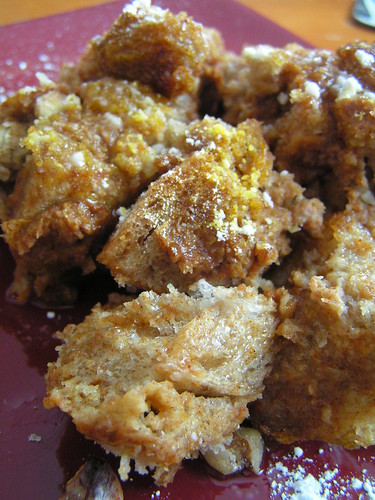
Now because I didn't add any sugar to the casserole the end result isn't overtly sweet. I prefer to sweeten it to taste on the plate with icing sugar and maple syrup (I also lived with my dad, who hated sweets so I tend to let people add their own sugar). However, if you're looking for a sweetened dish ready scoop and eat, I would mix in some maple syrup or brown sugar right into the pumpkin puree.

Serve alone, dusted with sugar, spices, citrus zest, berry sauce, syrup, ice cream or w/e.

alternatively if you like pumpkin, you could make this a savory dish by adding sauted garlic, Rosemary, thyme and onions to the pumkin mixture and extra earth balance.

Mentioning "Vegan" in your profile, and why it results in debates, attacks and general craziness

Subject: HMMM


user wrote:

Why are you vegan?

me wrote:

Primarily because I found out what when on in the meat, dairy and egg industry and decided it wasn't something I felt comfortable supporting.

user wrote:

Oh? And what happens in those industries?

me wrote:

:: GRAPHIC and POSSIBLY UPSETTING CONTENT:

If you are looking for a comprehensive overview, I would suggest downloading/renting Earthlings as it does a great job of covering various forms of exploitation.
Or http://www.veganoutreach.org/whyvegan/


Although I should warn you, the following is brief description of off the top of my head issues. It's not pleasant, and a bit graphic so please consider whether you want to read it before continuing.


Mostly issues relating to the constant impregnation of dairy cows, removing the calves after they are born, subsequent veal industry, hormone injections, decrepit conditions, abuses and confinement.

Laying hens kept in file drawer sized cages with 5-7 birds, again poor dirty cramped conditions.

Various slaughter house abuses, killing, skinning, dismembering, boiling etc while animals are still alive and conscious.

user wrote:

I have actually seen Earthlings for one of my classes. I subsequently set out to disprove my professor and what was shown in that video. You must understand that the footage they use is from only certain cases and does not reflect the industry as a whole. Consider beef -- here in Canada, there are a few types of cattle farms. There's the breeding farms, which only take calves away when they are fully weened, and there are feeder farms, which put cattle on a high-protein grain diet to get them bulked up to be used as meat.

Did you know the majority of beef produced in Canada obeys both Jewish and Muslim code?

I've been to a few farms around here in the maritimes, and I have seen no instance of abuse or poor conditions in them.

Hmm, how about PETA. Did you know their headquarters has a huge freezer built in it? They use it to store the corpses of animals they euthanize. They just so happen to euthanize over half of the animals they "save". They also pay people to firebomb animal shelters they suspect are "cruel".

It's fun to know both sides eh?

me wrote:

If you remember from the film, there is actually footage from a similar facility which was a kosher establishment (as in, it was supposed to be in accordance with Jewish slaughter codes).

I have also been to smaller stalk yards and farms, and have witness untreated ailments, dirty conditions, passes open trucks in freezing conditions taking animals to slaughter, and smaller Amish farms/auctions where calves where sold with wet umbilical cords.

I know very little about PETA and their tactics, as they aren't a group I particularly care for. I was aware they support euthanasia over live in shelters, as they consider a life in a shelter to be a cruelty (I'm don't agree with this sentiment, but I can understand how non-kill shelters can become negative living environments and serve as poor substitutes for lovings homes. However, because animals are unable to give us consent in ways we can understand nor are they able to express a desire to be 'put down' I don't really believe it is our place to decide when their lives are worth living and when they would be better off dead. As this likely varies on an individual basis).

I feel that no-kill live in shelters, if properly managed and run can be suitable living situation for animals. Provided that the set up differs greatly from the standard pound and these areas operate more like sanctuaries which while performing adoptions, are set up for the primary and live long care of abandoned animals.

However, as to the accusations/scandals to which you speak, well to be honest I know very little because once again, I don't support the majority of PETA's tactics, actions or campaigns. I believe their name, motto and perhaps end goals are worth while, however I feel that in their attempts to reach them they take steps and methods which should be avoided and overall give animal rights a bad name.

Although I do believe that PETA has a firm stance against direct action, injuries/threats to property or people. I do support the ALF, which a network of direct action activists who have commit felonies and destroyed private property. I however, am a fairly alone on this issue as most animal activists do not condone sabotage or destruction of personal property or breaking the law.

As I have been vegan and involved in animal rights for over 10 years, I have explored and listened to numerous versions of the other side from fundamentalists preaching religion, to people who simply believe my life choices are worthless, soft, stupid or otherwise, to individuals who have properly considered the ethical implications and simply decided they don't care. And finally to well educated individuals, who do their research and either research and purchase directly from sources that meet their personal ethical standards or who go so far as to raise their own animals for consumption to assure that they are fairly treated and slaughtered quickly.

Regardless, in the end it remains that the idea that one could ever find a source of meat, dairy, eggs ect that is free from exploitation and harm seems rather pointless. These relationships are exploitative by their vary nature, and although some may be more ethically sound than others, when it comes down to it, I don't need animal products and I don't want them. Personally, I don't believe the ends justifies the means.

Simply put, the idea of humane slaughter is hypocritical because taking the life of another (against their will/without their consent) is not a humane act. Although you may be able to find someone who will be swift and follow procedures, it remains a brutal act. As I would wish to have authority over my own body, life etc and I would like others to respect that, I feel it is only fair that I respect theirs.

If I have no reason or need to cause harm, why do it?


surprised at his responce

user wrote:

Well done madam, I applaud you.

I respect people that know what they stand for and can back it up well. There are too many "fakers" out there who just rant and roar about issues that they know nothing about.

However, you're obviously not one of them. You know whats up, you've done your homework. If someone says what you stand for is "worthless" or "stupid" you should give them a big whup upside the head, eh?

Oh, and yes, I knew about the Jewish factory thing from Earthlings, I figured you'd bring it right back up.

But now, I am so fighting the urge to mention that it is not difficult to retort responses which have no logical bearing on the discussion.

peta =/= nothing to do with veganism, our discussion of veganism, my veganism or any sub category there of
earthlings validy = hear say
jewish/muslim killing codes =/= ethical, moral, or king treatment of animals, just slightly less horrible

etc.


But i feel like I should resist and end with this good view on vegans.
I choose a median ground, not attacking the random retorts and confrontational nature he adopted but the faker comment

me wrote:

I don't believe that individuals who choose a lifestyle more intuned with their own personal ethics are 'fakers'. They are simply doing what feels right to them, regardless of their ability, experience, or knowledge relating to debates.

You don't need to conduct extensive research or explore the issues to decide what feels right or wrong to your own living or ethical standards.

Feeling strongly about something you believe in, in and of it self is note worthy. Knowing the issues, debates and politics around things are always good and worthy endeavours but they are no means pre-requisites to choosing compassion.


user wrote:

Nono, not so much a lifestyle in tune with what they believe. Consider genetically altered foods. Someone could have heard from someone else that they're going to wind up causing multitudes of adverse side effects if they eat the stuff. Thus, they decide they're not going to eat it, and nobody else should either.

There's a big difference between those who know why they are doing something, and those who don't.

me wrote:

I would agree however, when taking your previous statements/discussion into account the 'fakers' you are referring to would be people who have scene earthlings or other such documentaries and decided that they didn't approve of that kind of thing so they went vegan.

And it appears the argument you are proposing would be that, because not every single farm consists of that level of cruelty/abuse etc that those individuals shouldn't give up purchasing animal products. However, the issue being the lacks control system, check ups and general status of animals in this society means there is very little going on to prevent the kinds of situations depicted in this/similar media.

As such, the decision to avoid animal products, due to the correlated risk that such abuses are occurring at the facility from which your particular product came from would be deemed invalid. When in fact, in my opinion, not supporting an industry which allows those practices to occur would be a fare more logically conclusion than seeking out a farms and slaughter houses within that system that guard against those abuses.

because a) you would continue to support and industry in which the thing your opposed to, occurs in (i.e. the really bad abuses, hypothetically assuming you are fine with all other forms of abuse which occur).
b) slaughter houses deal with more than one farm, and vice versa, meaning the $ you input would be trickling back to both the farm and slaughter house you support and also others which may not uphold your ethical standards
c) one again, although not as cruel, chances are you would still find some discomfort to the overall treatment of animals as non living things, as this is the primary issue to which earthlings and other documents speak to (and what allows the lack of policing and abuses to occur in the first place).

Finally, that to imply that individuals who choose compassion based on a limited exposure to surface problems in the meat/etc industry as fakes, well just doesn't make sense. Fake would imply falsehood, dishonest pretences or attempting to appear as something they are not, when in fact they have simply made a gut ethical choice, without going into extensively exploring all issues and sub-issues. They are not claiming to be experts on the meat industry or veganism, they are just claiming to be opposed to factory farming and it's practices, of which they are actually opposed to.

Thursday, March 11, 2010

Jonathan Safran Foer on Ellen DeGeneres


Today, Jonathan Safran Foer, author of the bestselling book Eating Animals appeared on the Ellen DeGeneres show. Ellen, a committed vegan and quite possibly Oprah's heir as daytime TV queen, is in an unequaled position to advance veganism into the mainstream.


Thursday, March 04, 2010

Lights. Camera. Activism!

If a picture is worth a thousand words, then perhaps it could be said that a film is worth a thousand pictures. In my experience, there are few things more effective in veg outreach and education than screening films like "Peaceable Kingdom" or "The Witness."

There's no doubt, however, that there's a major dearth of short, pithy, and compelling films about animal issues. The Palo Alto Humane Society has set out this year to change that by inviting young filmmakers and activists to submit films to its first annual Humane Planet Film Contest. So, if you know how to get a good shot, have some editing chops, and most importantly have something to say, you should definitely check this out. The deadline is the end of March, and winners will take home a cash prize and get their films publicly screened.

Tuesday, February 16, 2010

Saturday, January 30, 2010

World's largest food service provider increases vegetarian options


Compass Group, the world's largest food service provider, recently launched their "Be A Flexitarian" initiative, drastically increasing the vegetarian options at over 8,500 cafeterias across the country.

The initiative's purpose is to, "...encourage people to 'Be a Flexitarian' by simply eating ONE meat-free meal a week." And by doing so, we can, "...make an impact on both our health and the environment."

The initiative was developed with the help of the Humane Society of the United States, which stated that, "...this initiative to promote the incorporation of more meat-free meals is the largest corporate program of its kind in the world."

This isn't Compass Group's first initiative to help animals, but it certainly is their biggest. Compass Group's U.S. cafeterias exclusively purchase cage-free shell eggs, and are large purchasers of hormone and antibiotic-free chicken, pork, turkey, and grass fed beef.

Thanks to the Be A Flexitarian initiative, I think we're going to see even more people seriously reducing their meat consumption, and becoming more open-minded to vegetarianism-- especially young people. Some of Compass Group's clients include Chartwells and Bon Appetit, which are both food service providers for hundreds of colleges across the country.

Compass Group's approach to addressing sustainable dining not only makes vegetarian eating more accessible, but also more appealing. Help spread the word of the Be A Flexitarian initiative by joining the Facebook page and inviting others.

Friday, January 29, 2010

Halifax's Vegan Association Recipe Zine! Call out for Vegan Recipes, Stories, Articles etc

The Halifax Vegan Association (and yours truly) are putting out a vegan recipe zine for free distribution to the public. I'm hoping to get both zine copies printed to be sent up and maybe host a scanned version of the original for an e-zine and so other groups will be able to re-print and distribute the zine to spread the vegan love.

As such I will be hosting a Vegan Recipe Zine Workshop on Sunday January 31th 2pm-6pm at the Dalhousie Women's Center in Halifax N.S., including Pizza and a community Potluck.

More importantly, for the extended vegan community (This means YOU! Internet) I am still looking for any recipe submissions, going vegan stories, articles, art work or simple zine pages you would like to have published in this zine.

Feel free to send me submission via e-mail (bad_blanch_amanda at hotmail).

Stay Vegan!