Tuesday, April 07, 2009

6 Ways to Become a Better Advocate for Animal Rights and an Ally of People of Color

This post is a summary of the statements expressed by people of color and their allies as documented in a five-part privilege series and is intended to assist animal activists, especially those who are identified as white, in becoming more effective at engaging in interracial communication about animal issues.

The following lists are meant to introduce you to 1) why some people of color may become outraged at human:animal oppression analogies, 2) how advocates create negative images of themselves in communities of color, 3) how they alienate advocates of color from the general AR community, and 4) six ways advocates can be more effective anti-oppression allies and advocates for animals. Finally, if you are interested in exploring how and why white and middle-class privilege can obstruct well-meaning efforts to engage with people of color who are and who are not already animal advocates, I have pasted a "table of contents" to previous posts.


Why analogizing human and animal exploitation/oppression often produces outrage and not empathy:
  1. aim to provoke people into debate in contrast to inviting people into a discussion
  2. are sponsored by organizations/people who have little or no history in promoting the “liberation” of the marginalized group whose oppression is being analogized to animals
  3. are insensitive to the existential trauma of and the meaning of “animal” to individuals of the marginalized group,
  4. assume that their oppression is history
  5. infer that their group lacks agency (just like "animals") and thus could not liberate themselves and depended upon an enlightened class of privileged citizens.

How do POC see vegans and AR activists (in general)?
The consequences of the aforementioned errors include the perception that vegans and ARAs
  1. exploit and appropriate the oppression of others for there own ends (without any prior request for consent and understanding)
  2. are racist because they fail to recognize the difference between human and non-human liberation (i.e. humans are self-organizing resisters, “animals” are not) and thus reduce the marginalized group to an “animal” condition of passivity
  3. cater to the white middle-class because they have taken no measures to make POC feel comfortable in their campaigns or abstain from consuming “cruelty-free” products that come at the expense of POC.
  4. care “more about animals than people (or color)” for the above reasons.

How do some white advocates alienate advocates of color from working together?
  1. Stereotype: “Have you ever eaten dog or cat?;” “Do you speak English?”
  2. Instrumentalize: “we need a black vegan for this event;” “if we adopt children of color, there will be more diversity in our movement”
  3. Exotify: “The best part of being vegan is getting to eat all kinds of exotic food”
  4. Marginalize: “Comparing human and animal oppression may hurt your feelings but it will help animals”
  5. Suppress: “Don’t criticize so-and-so because you’ll just be helping animal exploiters”
  6. Blame: “Don’t bring race into this! Why do you have to be so divisive?”
  7. Invalidate: “Get over it!” “You’re upset because you just don’t understand.”

How do (white) vegan and ARAs become better activists and allies?
The actions and their resulting consequences above serve both to hurt and alienate people of color from the animal/vegan movements(s) and construct the movement(s) as white middle-class, thereby creating a vicious cycle insensitivity and alienation. Therefore, a race-sensitive approach to promoting animal liberation and veganism ought to
  1. Be proactive! …don’t assume that POC are disinterested because they are not present
  2. Develop an understanding of POC’s existential condition and (one’s own) white privilege
  3. Humbly invite POC into a discussion (vs. use shock tactics and potentially offensive comparisons)
  4. Actively build bridges between movements and become an active ally in their liberation
  5. Engage with POC in issues they are already interested in (vs. using them as a means to your ends)
  6. Avoid language that alienates them by inferring that they are marginal Others (i.e. exotifying vegan food, homogenizing ethic groups, and scapegoating ‘foreign” cultures and nations).

Table of Contents
    Part 1:
  • Are Animals the New Slaves?
  • What Went Wrong?
  • Racism, Speciesism, and Cross-racial Misunderstanding
  • Are human-animal juxtapositions reductionistic?
  • Part 2:
  • Animal Rights or Animal Whites?
  • Animal White Supremacists?
  • Vegan Colonialism
  • One Word: Empathy
  • Part 3:
  • A Colorful Movement: Debunking the White Lie of White Exceptionalism
  • Making us Invisible: The Epistemology of Ignorance
  • The White Activist's Burden: Engaging the "Other"
  • Part 4:
  • Killing Us Softly: Narratives of Alienation
  • With Us or against Us –or- “Sit Down and Shut Up, Little Brown Girl”
  • Part 5:
  • Eating the Other: "Exotic" Food Fetishes
  • Are Vegans Oppressed?
  • The Police & White Privilege
  • Freeganism: The Privilege of Free Food?
  • Classism & Consumer Advocacy
  • Toward a Mutual Trust: Veganism as a Safe Place

Cross-posted @ HEALTH

Sunday, April 05, 2009

Star Starches


Featuring our favorite spud, the potato!
What better cheap, easy and oh-so-delightfully-filling product could there be?

The ways to prepare our fabulous spudding buddy are endless.
Wither mashed, baked, roasted, grilled, chilled, or fried potatoes make a great addition or composition to any meal.

Eaten with the skin the potato provides you with a rad assortment of vitamins and minerals, heavy on the C with some potassium and vitamin B6.

Its carbby goodness has filled many a hungry student belly, so when you take a break from saving animals do something nice for yourself and curl up with one of these fluffy baked delights and re-fuel your bad ass self.

Use them to bulk up, or compliment any meal. No matter what the menu, there is a potato accompaniment. If the cupboard is looking bare, then bake up one of these bad boys and top them anyway you'd like.

Happy eating!


(In our featured photo, we see the might spud enjoying a coating of paprika, pepper, earth balance, vegan bacon bits and some garlic salt. mmm)

*For further potato inspiration check out the link above!

Thursday, April 02, 2009

Are all animal/animal products nutritionally "bad"?


Recently, many vegetrian advocacy organizations have been celebrating the release of a new scientific study that finds a large, positive corrlation between the high consumption of red meat and all categories of health related mortalities. Such organizations and people, however, infrequently care to read all the findings and appreciate these types of studies in a more nuanced fashion. More sensational organizations will even disegard the truth of the matter and create a distorted frame just to get some media attention, thus losing credibility in the eyes of the better-read public. For instance, many vegetarian advocates ought to read the findings more carefully before approving of its finding which include that "
those [people] with high white meat intake had a slightly lower risk for total death". Taken alone, this study may sound the death knell for "red meat" only to usher in the reign of "white meat."

We must ask ourselves whether we should praise single nutritional studies as much as we do, and whether making very bold and controversial nutritional claims about "animal products" under a single-label is truly effective.

Before assuming animal flesh and dairy are essentially unhealthy for human biology, we ought to consider all the factors that may influence why "meat" and dairy are "bad" for "us," and not so bad for others. Perhaps the poor health consequences "meat" and dairy have on Americans has to do with a) the species of the animals eaten, b) their lifestyles and diets, c) the way they are cooked, d) the way they are eaten, e) the amount eaten, and f) what they are eaten with. Take any couple of these interrelated variables and alter them and you may end up with "
health paradoxes." Social/cultural practices of eating/killing animals and certain kinds of cuisine also play an important role in health outcomes. "Meat" may be culturally worse for human health than naturally worse.

Note that the results from the recent study only apply to Americans and specifically address "red meat" and
processed meats (from animals confined to feedlots)--much of which are cooked at high temperatures that release known carcinogens. Obviously the Standard American Diet is a nutritional time bomb, but what about the French and Masai diets that include high amounts of fatty cow's milk and ruminant flesh? Are the French and Masai's genetics that radically different from "our" own, or is it more likely that their nutritional fitness has more to do with (agri)cultural practices?

Michael Pollan has labeled the broad generalizations the public and scientific community takes from studies like these
"nutritionism"--which often backfires more than it helps by being appropriated by processed "food" marketers to seel their product to a scared and gullible public. Yet, these broad exertions of "meat is bad," not only is very reductive scientifically, but also in terms of acknowledging animal lives. In a sense, vegetarian advocates are saying meat = meat (i.e. corn-fed cow = wild salmon = broiler chicken, etc). Veg*ns, through this discourse, erase differences between species, breeds, and individuals' lifestyles by objectifying animal others as exchangeable bodies. By appropriating the discourse of "meat," we thereby make "meat" of animal others, as Carol Adams might say, by no longer addressing animal others' subjectivity, merely their fragmented corpses. Jacques Derrida, an extremely influential thinker among animal ethicists today, calls such a reduction of "animals" to "the animal"--or in this case "meat"--"carno-phallogocentrism".

Obviously, as a vegan, I don't endorse the commodification and slaughtering of animal others. I only hope our resentment of the harm from killing/eating animal others be more nuanced. Depending too much on health arguments, as others have argued,
distracts away from the moral/political reasons for veganism and exposes it to more dismissal.

If we want to address the health benefits of a vegan diet, we ought to do just that.

There is no evidence that one is any less healthy on a vegan diet and plenty of evidence to suggest one is healthier. With "meat" and dairy, however, I have yet to see any decisive evidence that it is *always* bad in *any amount* of *any kind.* I have yet to see a collection of studies condemning fish (without mercury contamination) and honey, for instance. It is thus reductive and naive to categorize all animal products under a single label as nutritionally "bad."

Certainly we ought to address the continual promotion of "healthier" and "humane" "meat" by the nutritional authorities of these studies at every opportunity, noting that vegan diets are equally, if not more healthy for generally everyone. Obviously, many researchers and doctors are concerned their advise will not be taken as seriously if they were to promote plant-based diets in our meat-centered culture, and may even wish to rationalize that certain "meat" is healthier than other kinds to make "us" all feel less concerned about the "food" that is literally craved. However, if a scientific study is published or there is a culture that doesn't fit within the paradigm, it is not going to convince anyone (but some vegans) to call such findings "backlash." We cannot rely on rhetoric and conspiracy theory to challenge sound scientific research. Science may not always be perfect, but it is up to the scientifically literate to criticise such claims, not anxsty activists (whether either for or against "meat").

Vegan diets by themselves are not necessarily healthy. What is most important in maintaining good health is a variety of whole produce, not merely the absence of animal products. After all, what is best about a pant-based diet is the high consumption of cancer-fighting and body-nourishing vitamens in plants; the commonality of "bad" fats (i.e. Omga-6s) are only contingently absent in plnt-based diets, not necessarily so. It is sufficiently compelling to recommend a vegan diet because animal products 1) are unnecessary for our health, 2) most often detrimental to health, 3) are generally catastrophic to ecological health, and 4) morally unjustified; these are all incontestable points, while "moderate consumption of animal products is no different" than moderate consumption of tobacco is not one.

Why risk our credibility with stretchy claims?

Monday, March 30, 2009

The Milkiest Non-Milk

As a vegan who could never stand the taste of soymilk (call me a heretic, if you will), I'm always on the lookout for alternative non-dairy milks. I've tried almond milk, rice milk, oat milk, and 'multigrain milk,' whatever the heck that is. Again and again, I have been disenchanted by watery, sugary, outrageously-priced, extraterrestrial-tasting, concoctions, that nobody, not even horrible, abominable people, like whoever invented the Grapple, should have to put in their morning cereal.

The other day, just as I was on the brink of surrendering the quest for a delectable, milky non-milk, I stumbled upon this blog entry with a recipe for homemade hemp milk. I happened to have some hemp seeds lying around, so I ventured to give it a go.

The result was unexpected: a creamy, sweet-but-not-too-sweet, only mildly-weird tasting brew that definitely topped, in my opinion, any store-bought milk (including store-bought hemp milk). Hemp has a singular flavor that takes some getting used to, but after just a few sips I was won over. My fellow taste-testers shared my enthusiasm.

Nutritionally speaking, hemp appears to outshine soy. A cup of hemp milk has about 14 grams of protein (though this figure varies depending on the brand of hemp seed). Hemp is also rich in Iron, B vitamins, Magnesium and Zinc (though it lacks the calcium and B12 of fortified soymilk). On the con side, hemp is less widely available, as hemp farming is outlawed in the United States (hemp belongs to the genus Cannabis, though it lacks the mind-altering traits of its popular cousin). If you can't find hemp at a local grocer, you can purchase from Amazon, or if you want to support a vegan grocery, from Food Fight, at a slightly higher price.

Earthlings, and some eating


Many of you may have seen Earthlings, by far one of the best films about animals. The Brown Animal Rights Club recently hosted a screening on campus, something that is always worthwhile. But although the film is generally well received, the segment about animal experimentation provokes skepticism.

Earthlings argues that scientific research on nonhuman animals does little to advance medical understanding because humans and other animals are physiologically different. The film goes so far as to claim that we can learn nothing about ourselves from such experiments. This claim is dubious at best. Are we really to believe that scientists have been fooling themselves all along, thinking their experiments were useful - - and that animal rights advocates somehow know better?

This is frustrating in an otherwise excellent documentary. Rather than make needlessly sweeping claims about all animal experimentation, we would do much better to emphasize how rarely the suffering caused can be justified by the objectives of the experiment.

On a lighter note, our group encouraged Earthlings attendees to join us for a vegetarian potluck later that week. The potluck was one of many Meatout events worldwide, and we enjoyed a variety of tasty dishes!

Tuesday, March 24, 2009

Perspectives on Abolition

In the articles linked to in the previous post, Gary Francione suggests that attempts at reforming and regulating animal industries are counterproductive and detrimental to animal rights. To share some alternate perspectives and maybe plant the seeds for discussion, here are a couple articles that present differing views on the value of incremental welfare reforms. First, here's an essay by Matt Ball of Vegan Outreach entitled “Welfare and Liberation: Mutually Exclusive?” Drawing lessons from the historical trajectory of the civil rights movement and other social justice causes, he contends that compromise and cooperation are essential ingredients for change in the animal rights movement. And here is a recent blog entry by Mark Hawthorne (the author of Striking At The Roots: A Practical Guide to Animal Activism) entitled “Are Animal Advocates Sleeping with the Enemy?” To get at the question of how aligned animal welfare efforts really are with industry interests, he surveys some recent agribusiness responses to Proposition 2, straight out of industry trade publications. Interesting stuff.

Saturday, March 21, 2009

Cora Diamond, a "Fellow Creature" of Animal Ethics

LEARNING TO BE A DUTIFUL CARNIVORE
By Jane Legge

Dogs and cats and goats and cows,
Ducks and chickens, sheeps and sows
Woven into tales for tots,
Pictured on their walls and pots.
Time for dinner! Come and eat
All your lovely juicy meat.
One day ham from Percy Porker
(In the comics he's a corker):
Then the breast from Mrs. Cluck
Or the wing from Donald Duck.
Liver next from Clara Cow
(No, it doesn't hurt her now).
Yes, that leg's from Peter Rabbit
Chew it well; make that a habit.
Eat the creatures killed for sale,
But never pull the kitty's tail.
Eat the flesh from "filthy hogs"
But never be unkind to dogs.
Grow into double-think-
Kiss the hamster; skin the mink.
Never think of slaughter, dear,
That's why animals are here.
They only come on earth to die,
So eat your meat, and don't ask why.


I first found this poem in a chapter Cora Diamond wrote over thirty years ago on animal ethics called "Eating Meat and Eating People." Diamond has a unique approach to the moral consideration of "animals" that is not your typical analytic run of logic as used by Peter Singer and Tom Regan. She argues that animals are morally considerable based upon our intuitive perception of them as "fellow creatures" who share a like existence as "human beings" who are intrinsically valuable as they are "human beings," not because of any single characteristic (i.e. sentience, rationality).Recently, a book was published as a response to her work on Philosophy & Animal Life as well as Nobel-prize winner J. M. Coetzee's works such as The Lives of Animals--a short, highly-recommended classic on animal ethics involving the fictional character Elizabeth Costello--and Disgrace.

It is quite surprising that she is not as well known among animal activists and academics since she is a very famous figure in her field of the Philosophy of Language and Wittgenstein. After all, this paper was written directly after Peter Singer's Animal Liberation (1975) and she has continued writing about animal ethics for the last thirty years. My suspicion is that the greater invisibility of her work is because of male privilege and the general privilege placed upon rational thought/Analytic philosophy in American universities. Though, I personally confess, that I find Singer's moral philosophy--which I no longer completely agree with--more convincing. But I think Diamond's arguments rightfully criticize Singer and other Analytics on their marginalization of disabled persons and their devotion to the morality of sameness (i.e. one has moral value based upon their proximity/similarity to each other, rather than having value as someone with different needs and a different consciousness).

Friday, March 20, 2009

Poor Gal's Soup

Here is a recipe for a soothing soup when your wallet is looking bare, perfect for all us struggling students.


Poor Gal's Soup:
  • Tomatoes (fresh is best, but canned works or a combo of both)
  • Onion (for a milder soup, green onions are best but they are pricer)
  • Garlic (I like garlic so I use 3-4 cloves)
  • oil
  • Water
  • Seasoning: Optional but this is best with fresh thyme and a little S&P
    • Thyme*
    • Rosemary*
    • Oregano*
    • Pepper
    • Cayenne if you like the heat
    • Mix it up and use whatever you have on hand or like
*On a super budget, Italian seasoning will do and you can use granulated or powdered
onion/garlic.

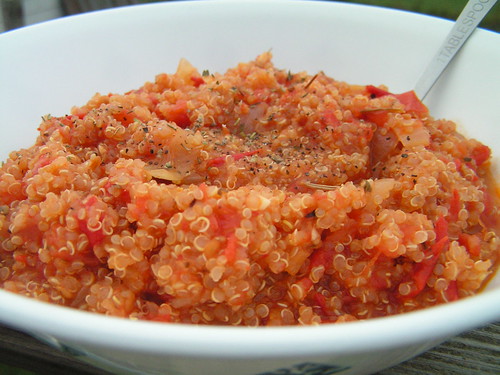
This soup is great with just the bare minimal (water, tomatoes, flavorings), but some easy add ins include: Small quick cooking pasta, rice, beans or lentils, veggies like greens, zucchini, peppers and anything you like. This time I had some Quinoa (lucky me!) so I used that.

Directions:
Heat your saucepan with a little bit of oil, chop your fresh garlic and onions add them to the oil and cooked until soft. If you like you can add your spices now to flavor the oil. Chop your tomatoes (or open your can). Add them as well, cook them for 3-4 minutes and then begin adding your water, it may look thin but as the tomatoes cook down you will begin to thicken the soup base into a surprisingly think and tasty broth.


Notes: if you are adding any extras like beans or veggies you can fry them with the tomatoes or simply add them after the water. Grains or pasta (uncooked) add them once the water is boiling.

This is a great light soup, easy for when you sick or studying, and filling when your fridge is bare.

Taste of Autum- Apple Cider Delights


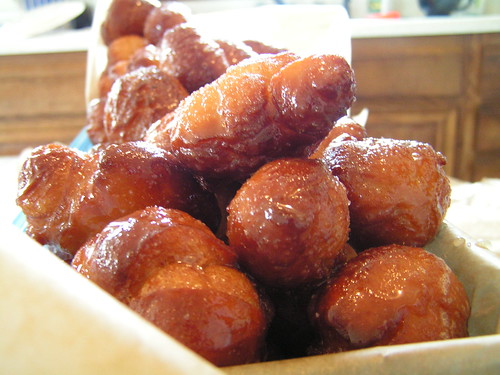
Inspired by esme's post about apple cider doughnuts I figured it was about time Vegan House had some doughnuts. So I looked back to the last time I made doughnuts and decided to make my very own doughnut recipe based using the lovely Random Girl's as a jumping point.

If your anything like me you won't be spending all day crafting Doughnuts unless you'll have them for some time to come. So I usually double all recipes (sometimes triple), with that in mind the recipe yields more than your typical batch. So feel free to double and triple again if you like.


Autumn Cider Doughnuts

2 package active dry yeast
1 cup warm water
1 cup warm apple cider
1/2 cup vegetable margerine
1 cup sugar (I've used both brown and organic cane sugar, I suspect maple and other healthier sweeteners would work as well, so feel free to experiment and let me know how it goes)

2/3 cup more apple cider, warmed
Egg replacer equilivent to 4 eggs
4 cups whole wheat
all-purpose flour
3-4 cups all purpose unbleached flour (again, for healthier doughnuts you could get away with all WW but they may be denser) {I say 3-4 as I keep the fourth cup to help kneed the dough and have never used the full cup but it could happen}
1 tsp salt 2 tsp Cinnamon and Nutmeg (More or less depending on taste)
Oil for frying


Glaze: 2 cups confectioners' sugar 1/2 cup hot vanilla soymilk


OR

Roll in:
1/2 cup sugar
2 TBS cinnamon
optional: vanilla

Dissolve the yeast packets in 1 cup of warm water and let the mixture stand until yeast clouds form (5-7 minutes).While your yeast is puffing up in a large saucepan, bring the first cup of cider to a boil. Add the margarine and sugar and stir until the margarine has melted and the sugar is dissolved. Remove from heat and COOL [believe me, I know you want to skip this step, but DON'T!]. In a separate measuring cup dissolve egg replacer and water (follow package directions, or use your favorite egg replacer recipe). When your mixture has cooled, add the puffy yeast and more warm cider. Stir in the egg replacer and 4 cups of WW flour. Mix the heck out of it. Add remaining all purpose flour slowly, reserving one cup for kneading and add the salt and spices. Mix some more, at this point you'll need to abandon your spoon (if you haven't all ready) and get in there with your hands. Again add the flour slowly, its for your own good. Only use enough to make a soft and manageable dough. Make sure to scrap down the sides of your bowl and get all your dough out. Now take your dough to a floured board and knead until smooth and elastic. Using your remaining flour to help prevent sticking, work as much as you need into the dough. Place the dough into a large greased bowl, cover and let it rise. It should doubled in bulk after about an hour.

Now again, if you are anything like me you now need to pee and your kitchen is trashed. So use this time to clean up (it'll save you in the long run).
After the hour has elapsed and you've re-cleaned your kitchen, punch down your dough (this part is fun!).

On a lightly floured surface roll out the dough until it is about 1/2 inch in thickness. Cut out doughnuts with a a glass or roll dough into tiny dough nut holes. Place the doughnuts/dough wads a greased baking sheet space them an inch apart or so. Make holes if you want. Now let them rise again for 1 hour. Re-clean if you need to.

Now the exciting part, heat your oil to in a deep skillet or deep fryer (test with the end of a wooden spoon, if bubbles form you are ready to fry!) . Fry doughnuts in small batched (as many as will fit with outcrowding at a time), until golden on both side. Drain on paper towels or old paper bads. Prepare your glaze or your sugar coating. To make your glaze, mix everything untill smooth in a shallow bowl. While the doughnuts are hot (but not hot enough to burn you), coat them in glaze or roll in sugar. You may need to make more sugar and/or glaze as you go, the thicker the better in my books either way let your glaze dry into the delightful crunchy sweet goodness we associate with doughtnuts. Oh, and by the way if don't you dare waste any glaze or sugar mixture, if you wind up with too much once the doughnut glaze/sugar has hardened or set pour/drizzle the rest over top of you pile.


*See my last doughnut post for info on baking doughnuts, it is possible and healthier but it will change the texture/taste. If you are kosher with that, then go to town.

Enjoy! and eat some veggies for gods sake.

Miso and Roasted Garlic Mashed Potatoes


An amazingly delectable dish with added health benefits of miso, making the classic Mashed Potato a healthier indulgence.

This recipe is extremely simple, you may use whichever miso you have on hand, I used dark.

3 large potatoes (diced into small cubes, leaving the skins on! They are good for you and we're trying to be healthy here)
1/2 red onion minced
1 T olive oil
3 large cloves of roasted garlic
1/2 T miso
1 T soy milk
1/4 Cup EB
Pepper

Chop you potatoes and boil in salted water until tender. Chop your red onion, preheat a cast iron skillet with Olive Oil and fry onions until crispy. While you wait on the potatoes combine the other ingredients and mash well (to insure there are no garlic chunks). Whip the miso mixture until smooth and combine with the cooked potatoes. Mash together. Top with your onions and enjoy.